
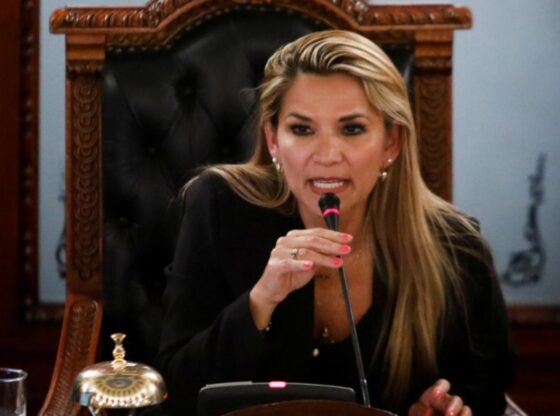

The Supreme Court of Justice of Bolivia annulled this Wednesday the ten-year prison sentence against the former interim president Jeanine Anez (2019-2020) and ordered his “immediate release” through the process known as ‘coup d’état II’, related to the political crisis of 2019.
The judicial resolution also provides for the release “on the day” for the former president after four years and eight months of imprisonment, which will have to be approved by a criminal execution judge, the president of the TSJ reported this Wednesday, Romer Saucedo.
“The annulment that she had has been ordered, the executory sentence of ten years has been ordered and consequently freedom has been ordered on the day, through the criminal execution judge who is in La Paz,” Saucedo told local media from Sucre, the constitutional capital of Bolivia.
She explained that during the review of the sentence “it has been seen that there were violations of the current legal system, these violations have affected due process, and also the rights that she enjoys.” “All that has been corrected and that is why the annulment of the sentence has been determined,” added Saucedo.
The determination arises after the former president’s defense presented an appeal for extraordinary review of the sentence to annul it, arguing that she should be prosecuted through a liability trial and not in the ordinary way as she was prosecuted and sentenced.
Áñez was serving ten years in prison for the case called ‘coup d’état II’, sentenced by the Bolivian Justice in June 2022, accused of illegally placing herself in the line of constitutional succession when she was second vice president of the Senate and after the resignation of Evo Morales (2006-2019) to the Presidency and that of his entire Cabinet.
Morales denounced a “coup d’état” against him after social protests that accused him of committing electoral fraud in the failed 2019 elections.
In August, two different departmental courts annulled two ordinary trials against Áñez for the death of several civilians when she was president in the cases known as ‘Senkata’ and ‘Sacaba’. These processes were transferred to a liability trial.
A liability trial must be heard by the Bolivian Legislature, an entity that must first approve it and then transfer it to the TSJ so that it can judge the case and issue a ruling.
Bolivian legislation reserves the judgment of responsibilities to senior executives of the State such as presidents, vice presidents, and judges of the high courts.